Results for "total station"

CHARGER CDC77

Spesifikasi:

  • The grey Topcon/Sokkia CDC77 Battery Charger charges the new grey DBC71 and BDC72 Li-Ion batteries.
  • Input: AC100-240V 50-60Hz
  • Output: DC8.28V 1.2Ax2


Note:
*Harga Dapat Berubah Sewaktu – waktu tanpa pemberitahuan terlebih dahulu.
*Mohon tanya ketersediaan barang terlebih dahulu.

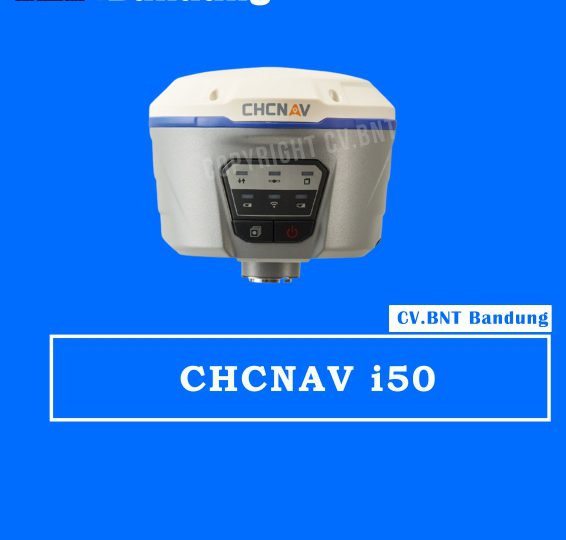
GPS RTK GNSS CHCNAV I50

Description:
The CHCNAV i50 GNSS receiver brings speed and accuracy in one easy-to-use GNSS solution to complete your surveying and construction projects efficiently.
Combined with CHCNAV LandStar 7 field software and HCE320 Android controller, the i50 is the perfect surveying solution for topographic and construction positioning tasks.

Key Features

  • 634 Channels Full GNSS
  • Extended Connectivity
  • Flexible Work Modes</li>
  • Rugged and Co
  • mpact
  • Extra Power

Specifications:

  • Power
    Operating power: min. (V) 7.4
    Operating power: max. (V) 36
    Typical consumption (W) 4.2
    Internal power supply 7.4
    External power 9 – 36
    Operating time with internal power supply (hr) 12
    Certifications CE
  • Environment
    Operating temperature: min. (°C)-40
    Operating temperature: max. (°C) 65
    Humidity resistance 95%
    Water sand and dust proof IP67
    Shock and vibration proof 2-meter pole drop
  • Performance
    No. channels 432
    Tracked satellite signals GPS, GLONASS, Galileo, BeiDou, SBAS, QZSS
    SBAS differential signals L1
    Type of measurements RTK, PPK, Static
    Reacqisition time (s) <1s
    RTK Network Compatibility >99.9%
  • Horizontal Uncertainty
    code: DGNSS/RTC (constant part) (m) 1.5
    code: DGNSS/RTC (variable part) (ppm) 3.0
    phase: RTK kinematic (constant part) (m)0.017
    phase: RTK kinematic (variable part) (ppm) 1
    phase: static post processing (constant part) (m)0.006
    phase: static post processing (variable part) (ppm) 0.5


Note:
*Harga Dapat Berubah Sewaktu – waktu tanpa pemberitahuan terlebih dahulu.
*Mohon tanya ketersediaan barang terlebih dahulu.

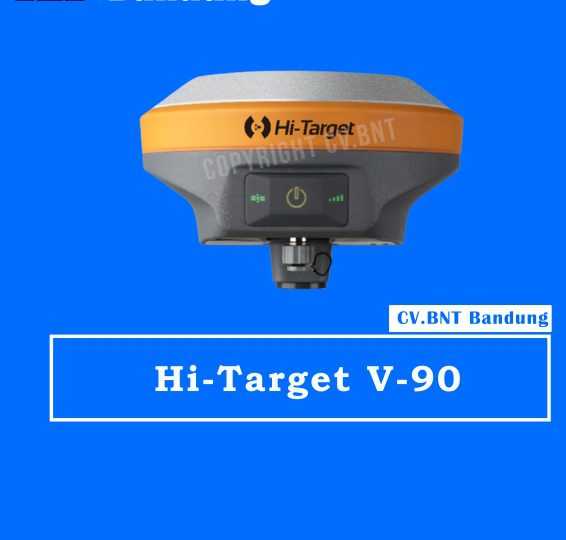
GPS RTK HI-TARGET V90

Fitur :

  • Kecil dan ringan
  • Beratnya hanya 950g.
  • Ukuran Diameter 153mm x Tinggi 83mm.

Pelacakan Multi-konstelasi GPS Geodetik RTK

  • 220 saluran pelacakan
  • Mendukung GPS, GLONASS, GALILEO, BDS, SBAS
  • NGS menyetujui antena GNSS pita penuh

Aplikasi Cerdas

  • Menawarkan survei kemiringan dengan sudut kemiringan maksimum 30 derajat.
  • Mendukung kalibrasi gelembung elektronik
  • Modul NFC internal membuat komunikasi Bluetooth cepat dan mudah.
  • Bantuan suara yang cerdas memandu operasi lapangan. Suara bisa DIY.
  • Data Rinex standar dan data mentah HI-TARGET direkam secara bersamaan.

Radio UHF Transceiver Opsional

  • Radio UHF transceiver memungkinkan mode kerja yang dapat dialihkan antara basis dan penjelajah.
  • Tiga jenis radio UHF internal menyediakan frekuensi yang berbeda berdasarkan kebutuhan pengguna. Radio UHF internal Pacific Crest TrimTalk © kompatibel dengan radio lain.

Koneksi Multi Jaringan

  • Mendukung GPRS, GSM dan WCDMA
  • Mendukung WIFI

Baterai yang Kuat

  • Didukung oleh baterai Li-ion berkapasitas tinggi (5000mAh) untuk memastikan pengoperasian sehari penuh

Desain Kasar

  • IP67 tahan debu dan tahan air
  • Mampu bertahan saat jatuh 3 meter secara alami ke beton


POSITIONING KINERJA

Statik dan Statik Cepat GNSS Survei

  • Horisontal …………………… 2.5mm + 0.5ppm RMS
  • Vertikal…………………………. 5mm + 0.5ppm RMS
  • Post Processing kinematik (PPK / Stop & Go) GNSS Survei
  • Horisontal ……………………… .. 1cm + 1ppm RMS
  • Vertikal ………………………… 2,5 cm + 1ppm RMS
  • Waktu inisialisasi ……… .Typically 10 menit untuk basis sementara 5 menit untuk rover
  • Kehandalan inisialisasi …… Biasanya> 99,9

Real Time Kinematik (RTK) Survei

Base Absolute

  • Horisontal ……………………… .. 8mm + 1ppm RMS
  • Vertikal…………………………. 15mm + 1ppm RMS
  • Jaringan RTK
  • Horisontal ……………………… .. 8mm + 0.5ppm RMS
  • Vertikal ………………………… .. 15mm + 0.5ppm RMS
  • Waktu inisialisasi …… .. … Biasanya <8 detik
  • Kehandalan inisialisasi …… .Typically> 99,9%
  • Positioning kode Differential GNSS
  • Horisontal………………………. 25cm + 1ppm RMS
  • Vertikal …………………………… 50cm + 1ppm RMS
  • SBAS ……… 0.50m Horizontal, Vertikal 0.85m

HI-TARGET Internal UHF Radio (Standard)

  • Frekuensi … 450 ~ 470MHz dengan 116 saluran
  • Daya transmisi … 0.5W, 1W, 2W disesuaikan
  • Kecepatan transmisi ……… .9.6Kbps, 19.2Kbps
  • jarak antara base dan rover ………… 0,3 ~ 5km khas, 8 ~ 10kmoptimal
  • Pacific Crest XDL Micro internal UHF Radio
  • Frekuensi …………………………… 0,403 ~ 473MHz
  • Transmisi daya ……………… 0.5W, 2W disesuaikan
  • Transmisi kecepatan …………….. Sampai 19.2Kbps
  • Mendukung sebagian besar protokol komunikasi radio
  • jarak antara base dan rover ……………………… 3 ~ 5 kilometer khas, 8 ~ 10km optim

HI-TARGET Internal UHF Radio (Standard)

  • Frekuensi … 450 ~ 470MHz dengan 116 saluran
  • Daya transmisi … 0.5W, 1W, 2W disesuaikan
  • Kecepatan transmisi ……… .9.6Kbps, 19.2Kbps
  • jarak antara base dan rover ………… 0,3 ~ 5km khas, 8 ~ 10kmoptimal
  • Pacific Crest XDL Micro internal UHF Radio
  • Frekuensi …………………………… 0,403 ~ 473MHz
  • Transmisi daya ……………… 0.5W, 2W disesuaikan
  • Transmisi kecepatan …………….. Sampai 19.2Kbps
  • Mendukung sebagian besar protokol komunikasi radio
  • jarak antara base dan rover ……………………… 3 ~ 5 kilometer khas, 8 ~ 10km optim

SISTEM KONFIGURASI

Sistem

  • Penyimpanan data 16GB internal storage (Mendukung hingga 32GB SD card eksternal)
  • Rekam GNS dan Format RINEX secara bersamaan


Data Format

  • Output posisi 1HZ, hingga 20Hz
  • CMR : CMR, CMR +, sCMRx input dan output
  • RTCM : RTCM 2.1, 2.3, 3.0, 3.1, 3.2 input dan output
  • Navigasi output ASCII : NMEA-0183 GSV, AVR, RMC, HDT, VGK, VHD, ROT, GGK, GGA, GSA, ZDA, VTG, GST, PJT, PJK, BPQ, GLL, GRS, GBS
  • Navigasi output biner : GSOF

Note:
*Harga Dapat Berubah Sewaktu – waktu tanpa pemberitahuan terlebih dahulu.
*Mohon tanya ketersediaan barang terlebih dahulu.

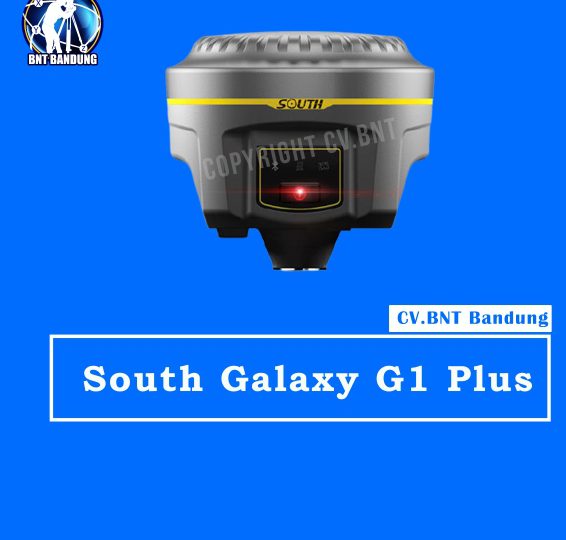
GPS RTK South Galaxy G1 plus

FEATURES:

  1.  Behind every significant epoch-making change in human society, always accompanied by the birth of an important technology.
  2. Computer and electronics make surveying and mapping industry achieve a span from the analog age to the digital age.
  3. And the development of Internet technology further opens the prelude of surveying and mapping information age.

SPESIFICATION:

GNSS performance

  • Channels: 336, 555 (optional)
  • GPS : L1 C/A, L2E, L2C, L5
  • Positioning output rate : 1Hz~50Hz
  • Initialization time : <10s
  • Initialization reliability : >99.99%

Positioning precision

Static surveying

  • Horizontal: 2.5mm+0.5ppm
  • Vertical : 5mm+0.5ppm

Code differential positioning

  • Horizontal: 0.25m+1ppm
  • Vertical : 0.50m+1ppm

Real-time kinematic surveying

  • Horizontal: 8mm+1ppm
  • Vertical : 15mm+1ppm

RTX

  • Horizontal: 4-10cm (5-30min)
  • Vertical : 8-20cm (5-30min)

User interaction

  • Operaing system : Linux
  • Buttons : 2 buttons operation
  • Indicators: 5 indicate lights
  • Web UI : Freely to configure and monitor the receiver by accessing to the web server via Wi-Fi and USB

Hardware performance

  • Dimension: 135mm (Diameter) x 125mm (Height)
  • Weight : 1.39kg (with two batteries)
  • Material : Magnesium aluminum alloy shell
  • Operating temperature : -30°C~ +65°C
  • Storag temperature: -40°C~ +80°C
  • Power Supply: 9-25V DC, overvoltage protection
  • Battery : Rechargeable, removable Lithium-ion battery, 7.4V 3400mAh/per

Communications

  • I/O port : 5-PIN LEMO external power port + RS232, 7-PIN external USB(OTG)+Web accessing, 1 radio antenna interface, SIM card slot
  • Frequency Range: 410-470MHz
  • External Devices: Optional external GPRS/EDGE dual-mode communication module, switchable

Data storage/ Transmission

  • Data Storage : 8GB SSD internal storage, changeable record interval, up to 50Hz raw data collection
  • Data Format (Static data format) : STH, Rinex2.x and Rinex3.x


Note:
*Harga Dapat Berubah Sewaktu – waktu tanpa pemberitahuan terlebih dahulu.
*Mohon tanya ketersediaan barang terlebih dahulu.


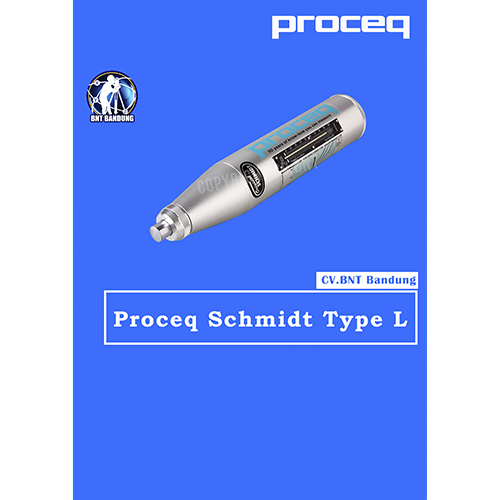
Deskripsi Proceq Original Schmidt Type L – Concrete Hammer Test
Proceq Original Schmidt Type L

DIFFERENCE Type N & L:
* Type N: Standard impact energy. Minimum thickness of test object: 100 mm (3.9”’) and should be firmly fixed in the structure
* Type L: Low impact energy. Suitable for brittle objects or structures less than 100 mm (3.9”’) thick

OVERVIEW:
The original Schmidt hammer, type L is the ideal option for testing thin walled items with a thickness between 50 to 100 mm (2”” and 4”’) or for analyzing small components. It is also suitable for examining cast stone components which are sensitive to impact. In rock mechanics, the type L Original Schmidt is commonly used for the classification of rock cores and brittle rock.

The Type L Hammer is a portable and relatively inexpensive nstrument for measuring the surface hardness of rock. The hammer can be used efficiently in both the laboratory and the field.

The mechanism of operation is simple: a hammer released by a spring, indirectly impacts against the rock surface through a plunger and the rebound distance of the hammer is then read directly from the scale ranging from 10 to 70 MPa (1,450 to 10,152 psi).

The type L hammer is used on NX or larger core specimens or block specimens having an edge length of at least 6 cm. TC-3040 Calibration Anvil, manufactured from a special steel alloy, is used for the calibration of test hammers.


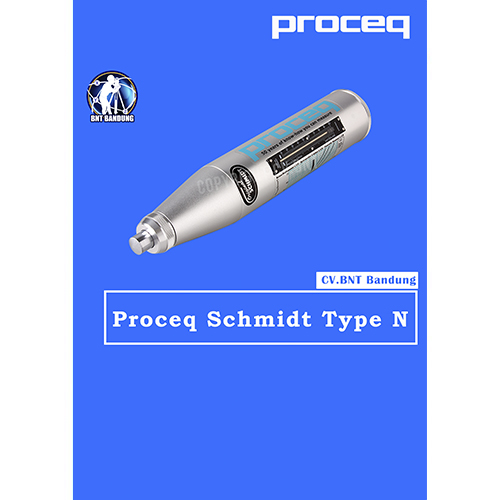
Deskripsi Proceq Original Schmidt Type N – Concrete Hammer Test
Proceq Schmidt Hammer, Type N

DIFFERENCE Type N & L:
* Type N: Standard impact energy. Minimum thickness of test object: 100 mm (3.9”’) and should be firmly fixed in the structure
* Type L: Low impact energy. Suitable for brittle objects or structures less than 100 mm (3.9”’) thick

OVERVIEW:
The original Schmidt hammer, type N, is designed for non-destructive testing of concrete items 4″ (100mm) or more in thickness, or concrete with a maximum particle size less than or equal to 1.25″ (32mm). It is designed for testing concrete within a compressive strength range of 1,450 to 10,152 psi (10 to 70 N/mm2) and impact energy of the test is 1.6 ft-lbs (2.207 Nm). The (type N) Schmidt hammer is pressed against the concrete structure and the rebound values are displayed on a mechanical sliding scale. These values can then be correlated to compressive strength by using the conversion table chart affixed to the hammer. The original Schmidt hammer is known for its durability and accuracy.